
3% vs 5% Solar Shades: Which Openness Factor Should You Choose?
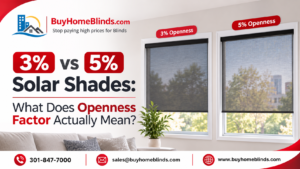
When shopping for solar shades, you may come across terms such as 1%, 3%, 5% or 10% openness. These numbers can be confusing if you have never purchased solar shades before.
The openness factor describes how much of the fabric is made up of tiny openings. It helps indicate how much light and visibility may pass through the material.
For homeowners comparing 3% vs 5% solar shades, the decision usually comes down to balancing outdoor visibility with sunlight and glare control.
What Does 3% Openness Mean?
A 3% openness solar shade has a relatively tight weave compared with a 5% fabric. It generally offers less visibility through the material and can provide stronger glare reduction, depending on fabric color and construction.
Consider 3% openness when:
-
Your windows receive strong direct sunlight.
-
You want more daytime privacy than a more open fabric may provide.
-
You work near a bright window.
-
You want to reduce glare on screens or television displays.
However, 3% does not mean complete privacy or blackout. Lighting conditions still matter.
What Does 5% Openness Mean?
A 5% openness fabric has larger openings than a 3% fabric. This generally allows more daylight and outdoor visibility to pass through.
It may be a good option when:
-
You want to preserve more of your outdoor view.
-
Your room needs natural daylight.
-
You want to soften sunlight without making the window feel too covered.
-
Your windows overlook a garden, yard or attractive view.
The actual appearance depends on fabric color, material and the direction of sunlight.
3% vs 5% Solar Shades: Comparison
| Factor | 3% Openness | 5% Openness |
|---|---|---|
| Fabric openings | Smaller | Larger |
| Outdoor visibility | More limited | More visible |
| Daylight | Generally less | Generally more |
| Glare control | Often stronger | Often more moderate |
| Daytime privacy | Usually greater | Usually lower |
| Best suited for | Strong sunlight and glare | Balanced daylight and views |
Which Openness Factor Is Better for West-Facing Windows?
West-facing windows can receive strong afternoon sunlight. If glare is a daily problem, a tighter openness fabric such as 3% may be worth considering.
If maintaining an outdoor view is more important, 5% may be preferable.
The best selection also depends on the window size, surrounding buildings, room usage and fabric color. A sample viewed in your actual room can help you judge the difference.
Does 3% or 5% Provide Nighttime Privacy?
Neither openness factor should be treated as a guaranteed nighttime privacy solution.
Solar shades are designed primarily for sunlight and glare management. When indoor lights are on after dark, visibility through the fabric can change significantly.
If nighttime privacy is essential, consider a different product or a layered setup. Blackout and room-darkening shades may be a better fit for bedrooms.
Why Should You Order Samples Before Choosing?
A fabric can look different on a product screen than it does in your home. Wall colors, window direction and daylight all influence how a shade appears.
BuyHomeBlinds offers window treatment samples so customers can review materials before making a final decision.
Frequently Asked Questions
1. Is 3% solar shade darker than 5%?
A 3% fabric generally has smaller openings and may filter more sunlight, but the final appearance also depends on fabric color and construction.
2. Do 5% solar shades provide privacy?
They can provide some daytime privacy depending on lighting and surroundings, but they should not be relied on for nighttime privacy.
3. Are 3% solar shades better for west-facing windows?
They may be useful where afternoon glare is strong. A 5% fabric may be better if preserving the view is a higher priority.
4. Do solar shades block UV rays?
Many solar shade fabrics are designed to reduce UV exposure, but the exact performance varies by fabric. Check the product specifications.
5. Can I see samples before ordering?
Yes. BuyHomeBlinds provides samples for customers to review material and color options before ordering.
Compare Solar Shade Fabrics for Your Home
Choosing between 3% and 5% openness is easier when you compare actual fabrics in your own lighting conditions. Explore custom solar shades and request samples before making your choice.
For homeowners in Maryland, Washington DC and Northern Virginia, call 301-847-7000 to arrange a free in-home consultation.